
How to Safely Transition to A New Run Shoe

So, we've covered how run shoes can play a role in running related injuries by affecting the degree of load on your body in our article, Do Run Shoes Matter? Now suppose a change in run shoe is in your future, how should you transition to a new make or model?
While a change in shoe may help you prevent injury, a sudden or drastic change is likely to cause injury. Sudden changes to a lower drop shoe, for example, can lead to achilles tendonitis, fracture in the bones of the foot, or shin splints.
The injuries caused by shoe changes usually occurs because the change was too drastic or too abrupt or both. Your muscles adapt over time to shoewear. You may have shortened and or weakened muscles if they were highly cushioned or had a significant drop. These muscles may not tolerate a change without addressing strength and flexibility first.
A gradual change in cushion and drop is critical. For example, someone who is currently running in a 12mm drop model should ease into a 10mm drop as opposed to jumping from a 12mm to 4 mm drop.
Likewise, someone who is running in a high stability model or one with lots of cushion should gradually move to a moderate/middle before moving onto a minimal/low. When shopping for new run shoes, ask the salesperson for the specs on the models that you are trying and compare them to your current ones.
Shoe Change DO’s:
start with shorter distance runs (2-3 miles)
alternate your runs with the new/old shoes
choose a model that provides a gradual change
listen to your body - slight post workout soreness may accompany your change but you should not experience pain.
strengthen muscles of the foot and calf when transitioning to less drop.
Shoe Change DON’Ts:
Do NOT change shoes just weeks before your race.
Do NOT change shoes if you are battling an injury for which you are not being treated.
Do NOT continue with the new shoes if you experience pain.
Many factors including running habits (volume, surface), foot strike, strength, cadence, goals, past injury history etc. all play a role in the make and model that is best for you. If you are currently suffering from an injury, you should be evaluated and treated before making any changes in shoe.
Do Run Shoes Matter?
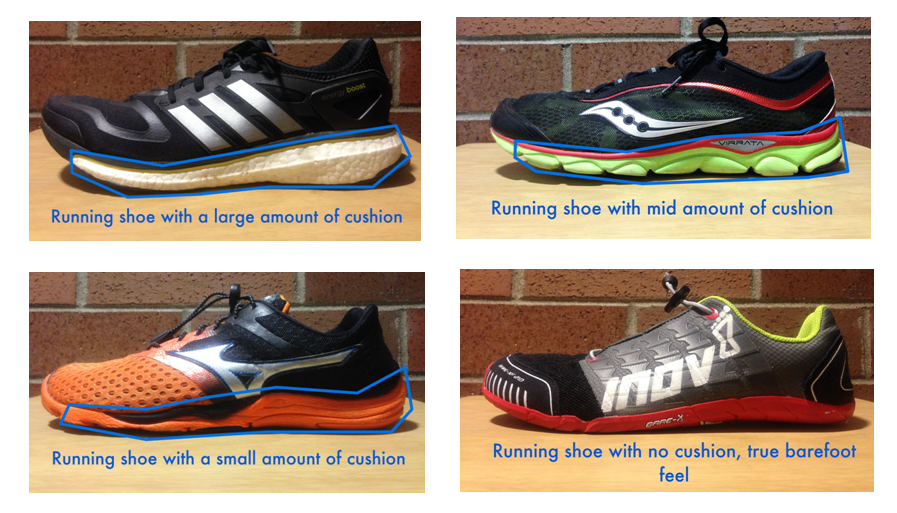
Shoe used in Rice, Davis, Jamison study is shown bottom, right.
The answer is, yes! A soon to be released scientific study shows that forefoot runners (those that land on the ball of their foot - see photo below) experience less impact forces in the lower extremity with a minimalist shoe. [1] A minimalist shoe is defined as minimal cushioning and a heel-toe drop less than or equal to 4 mm as compared with a standard run shoe.
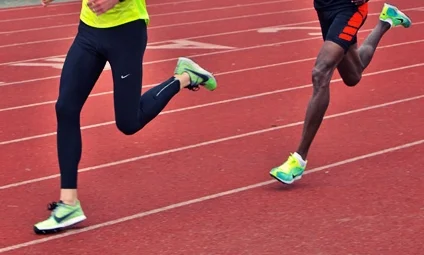
Forefoot Landing
There are several studies that reveal increased load on the lower chain whilst running/jumping on cushiony shoes and surfaces.[2] Seems counterintuitive doesn’t it?
A study is currently being conducted specifically testing a brand that sells models that are specially highly cushioned. I won't mention the brand here but since I've seen runners wobbling around in them, I've been cranky. I’ll keep you posted.
So generally speaking based on scientific studies, cushion + more drop = more force. More force can mean greater risk for specific running injuries.[3]
Run shoes are not the only factor on impact forces and possible running injury. I’d say they play a relatively small role in comparison. But, when you consider that running is jumping on one foot over and over again at three times your bodyweight and there are shoes that lead to increases in force sustained by the body, it stands to reason that they do matter.
So, if you are a forefoot runner should you go out and buy the least cushion and lowest drop shoes on the market and head out for a long run? If you currently wear cushion shoes, should you throw them to the curb and replace them with minimalist shoes? Ummmm....no!
For details on how to transition, check out my post: How to Safely Transition to New Run Shoes.
[1] Rice H, Jamison S, Davis I. Footwear Matters: Influence of Footwear and Foot Strike on Loadrates During Running. Medicine and Science in Sports and Exercise Coming Soon.
[2] Bishop M, Fiolkowski P, Conrad B, Brunt D, horodyski M. Athletic footwear, leg stiffness, and running kinematics. J Athl Train 2006;41 (4):387
[3] Zadpoor AA, Nikooyan AA. The relationship between lower-extremity stress fractures and the ground reaction force: A systematic review. Clin Biomech 2011;26(1):23-8.